Rooted in Kerala's folk medicine traditions and codified in the Sahasrayoga, this intensely warming oil targets the twin forces of Vata and Kapha within joints — dissolving morning stiffness and restoring mobility.
Folk Roots and Classical Integration
The lineage of Kottamchukkadi Kuzhambu highlights the profound integration of regional folk medicine (Deshiya Chikitsa) into classical Sanskrit pharmacology. Originating as a highly effective tribal and domestic home remedy in the lush landscapes of Kerala, this specific botanical combination was later codified by senior scholars and recorded in the Tailaprakarana section of the Sahasrayoga, the definitive compendium of Kerala's clinical wisdom.
While classical northern textbooks heavily favor complex, multi-herb combinations for general pain, Kottamchukkadi Kuzhambu stands out for its elegant, highly targeted design. It is formulated specifically to confront the twin pathological forces of Vata and Kapha within the joints. By utilizing a heavy, warming sesame oil base — further enriched in its kuzhambu form with castor oil and ghee — the formulation addresses deep tissue congestion and poor circulation with exceptional efficiency.
Core Botanicals and the Power of Chinchapatra
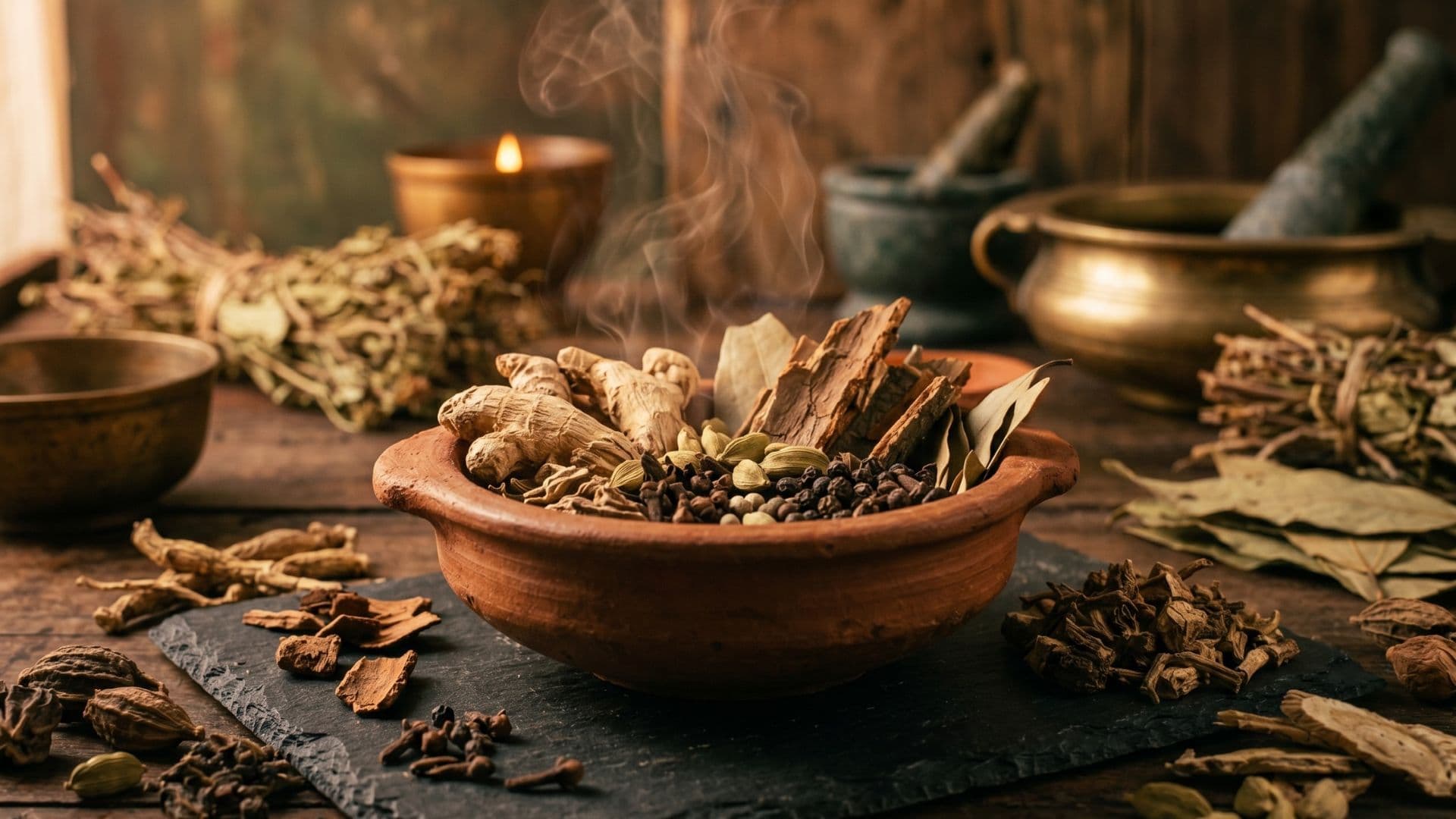
The therapeutic power of Kottamchukkadi Kuzhambu is anchored by its two namesake ingredients: Kottam (Saussurea costus) and Chukku (dry ginger, Zingiber officinale). These are supported by a group of highly warming and stimulating botanicals, including Vayambu (Acorus calamus), Lasuna (garlic), Sigru (Moringa oleifera), Siddarthaka (mustard), Rasna (Alpinia galanga), and Devadaru (Cedrus deodara).
A defining feature of this traditional preparation is the extensive use of Chinchapatra Swarasa (freshly expressed juice of tamarind leaves) as the primary boiling liquid (Drava dravya). The intense sourness of the tamarind juice acts as a potent pharmacological catalyst, dilating the local blood vessels and helping the lipid base carry the active herbal molecules deep into the joint capsules.
| Ingredient | Scientific Name | Primary Property | Clinical Benefit |
|---|---|---|---|
| Kottam | Saussurea costus | Deeply warm, anti-microbial, anti-inflammatory | Resolves local metabolic waste (Ama) and reduces joint pain |
| Chukku | Zingiber officinale | Highly pungent, digestive, thermogenic | Digests systemic endotoxins and relieves morning stiffness |
| Sigru | Moringa oleifera | Penetrating, anti-edematous, diuretic | Physically draws out deep tissue edema and joint effusion |
| Siddarthaka | Brassica juncea | Stimulating, thermogenic, lymphatic cleanser | Clears congested lymphatic pathways around swollen joints |
| Devadaru | Cedrus deodara | Analgesic, anti-spasmodic, neuroleptic | Blocks deep structural pain and calms hyperactive nerves |
Physiological Mechanics: Resolving Ama and Pacifying Kapha-Vata
In the clinical understanding of arthritic conditions, joint stiffness is rarely a simple case of structural wear and tear. Instead, it is frequently driven by Ama (undigested, toxic metabolic byproducts) that has accumulated within the micro-channels (Srotas) of the joints, combining with aggravated Vata to block normal movement. This state, known as Amavata or Margavarodha (pathway obstruction), is characterized by a heavy, cold stiffness that makes morning movement painful and restrictive.
Kottamchukkadi Kuzhambu targets this pathology through its powerful warming and digesting (Amapachana) properties. Chukku and Kottam possess a highly pungent taste and hot potency, which stimulate local tissue digestion, breaking down the cold, sticky molecules of Ama directly within the joints. Simultaneously, Sigru and Siddarthaka act as natural, localized diuretics. Upon transdermal absorption, they physically draw out excess fluid and inflammatory cytokines from the joint space, resolving chronic edema and swelling. The analgesic properties of Devadaru and Lasuna then work to desensitize local pain receptors, while the rich, warming lipid base lubricates the dried tendons and ligaments to restore smooth, painless movement.
Clinical Manifestations and Therapeutic Indications
This warming formulation is traditionally used when joints feel stiff, cold and heavy — particularly the knees, hips, lower back and neck. It is particularly effective for post-traumatic swelling, ankle sprains, and sports injuries where fluid has accumulated around the joint, leading to a severe loss of mobility.
In clinical practice, choosing between the standard Kottamchukkadi Thailam (pure sesame oil base) and Kottamchukkadi Kuzhambu (triple-lipid base) requires careful diagnostic analysis. While the thailam is excellent for general massage and milder, localized Kapha stagnation, the kuzhambu is preferred for chronic, deeply set joint degeneration and severe muscle wasting. The inclusion of castor oil and ghee in the kuzhambu provides a much heavier, more lubricating barrier that retains heat at the joint site for a longer duration, ensuring that deeply depleted tissues receive continuous nourishment and protection.
Application Guidelines and Safety
For optimal clinical results, Kottamchukkadi Kuzhambu should be warmed slightly and massaged over the affected joints in gentle, circular motions around the bony landmarks, and in long, downward strokes along the connected muscle bellies. The oil should be left on the skin for at least thirty to forty-five minutes to allow the warming herbs to fully penetrate the subcutaneous tissues and reach the joint capsule, then washed off with warm water.
Because of its highly heating and stimulating nature, this oil must never be applied when there is active, acute inflammation characterized by severe burning sensations, throbbing pain, or raw redness. In these highly active inflammatory states, the hot potency of Chukku, Kottam, and tamarind juice will aggravate the localized heat, worsening the pain. For such conditions, a cooling, Pitta-pacifying approach must be prioritized instead.
Is this oil right for you?
Ask Mini Bhal Vaidya on WhatsApp — she will advise you personally.
Ask on WhatsApp