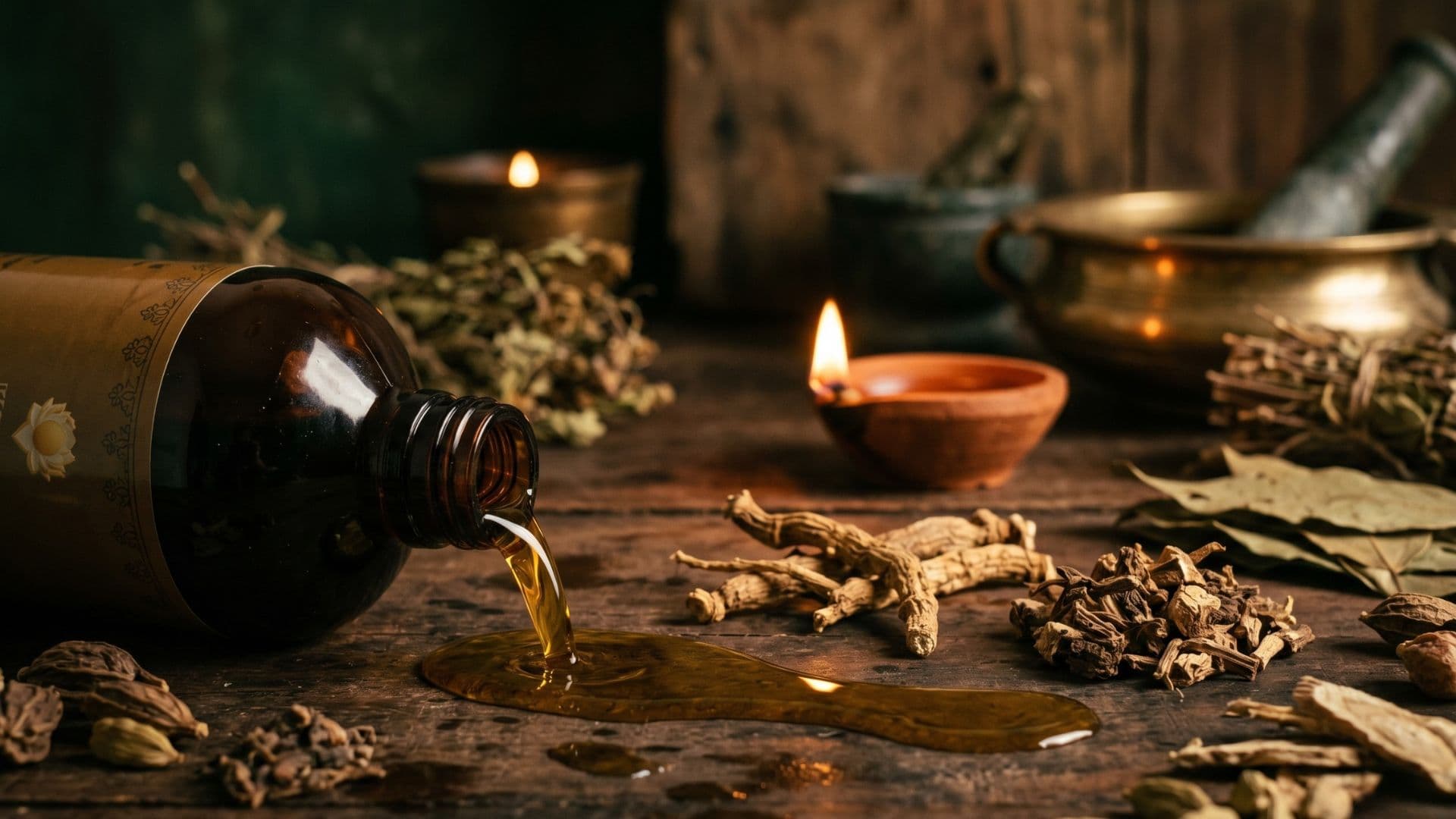
One of Kerala's most revered therapeutic oils — a sophisticated triple-lipid formulation traditionally used for centuries to support recovery from sciatica, spinal stiffness and postpartum weakness.
Historical Evolution and the Alchemy of Mukkutt
A kuzhambu represents a highly specialized pharmaceutical dosage form developed by the traditional Vaidyas of Kerala through generations of clinical experimentation. While classical Sanskrit treatises of northern India primarily focus on single-lipid medicated oils (Sneha Kalpana), the legendary Ashtavaidya families of Kerala recognized that chronic, deeply seated neurological and musculoskeletal disorders require a more complex vehicle. Thus emerged the concept of Mukkutt (classically known as Trivrit Sneha), which replaces a single oil base with an intricate, precisely proportioned blend of three distinct therapeutic lipids: sesame oil (Tila Taila), castor oil (Eranda Taila), and cow's clarified butter (Go-Ghrita).
This pharmaceutical masterpiece is historically documented in the Pharmacopoeia of the Government Ayurveda College in Thiruvananthapuram under the nomenclature Dhanvantharam Mukkut. By synthesizing these three lipids, the formulation achieves an unprecedented level of viscosity, tissue permeability, and heat retention. This physical profile makes the kuzhambu especially well suited to intensive Kerala therapies such as Abhyanga (medicated massage), Pizhichil (oil pouring), and Dhara. It is classically indicated for severe Vata-Nanatmaja Vyadhis (diseases caused exclusively by Vata) and Pittanubandha Vata Vyadhis (Vata disorders with secondary Pitta involvement).
Herbal Composition and Synergistic Chemistry
The pharmacological efficacy of Dhanwantharam Kuzhambu lies in its complex formulation, comprising forty-six botanical agents processed in a nourishing aqueous-lipid medium. The primary therapeutic anchor is the root of Bala (Sida cordifolia), classically boiled in a vast volume of water and reduced to a highly concentrated decoction, then processed alongside rich cow's milk. This is synergistically combined with Dashamoola (the group of ten sacred roots), which acts as a powerful systemic anti-inflammatory agent, and a decoction of grains such as barley (Hordeum vulgare), jujube (Ziziphus jujuba), and horsegram (Dolichos biflorus) to provide deep tissue nutrition.
A delicate paste (Kalka) of secondary botanicals is introduced during the boiling process. This paste includes rejuvenative herbs like Manjistha (Rubia cordifolia), Devadaru (Cedrus deodara), and sarsaparilla (Hemidesmus indicus), which work in harmony to purify the blood, reduce swelling, and soothe nerve endings.
| Ingredient | Botanical Name | Part Used | Therapeutic Action |
|---|---|---|---|
| Bala | Sida cordifolia | Root | Pacifies Vata & Pitta, strengthens muscle fibers, restores vitality |
| Dashamoola | Ten Sacred Roots | Roots | Reduces deep-seated systemic inflammation and relieves muscular spasms |
| Eranda Taila | Ricinus communis | Castor Oil | Alleviates neurogenic inflammation and offers rich thermal retention |
| Go-Ghrita | Cow's Ghee | Clarified Butter | Transports lipophilic herbal molecules to deep bone and joint tissues |
| Tila Taila | Sesamum indicum | Sesame Oil | Penetrates micro-channels (Srotas) to lubricate dry, depleted structures |
Vata-Pacifying Physiological Mechanics
To understand how Dhanwantharam Kuzhambu resolves chronic pain, one must analyze the physical chemistry of its triple-lipid vehicle. Castor oil, rich in ricinoleic acid, exerts powerful anti-inflammatory and analgesic effects by acting directly on sensory neuropeptide-mediated neurogenic inflammation, mimicking the localized desensitization properties of capsaicin. Simultaneously, cow's ghee serves as an exceptional Yogavahi (bio-enhancing vehicle), capable of crossing lipophilic cellular barriers to carry the heavy, strengthening properties of Bala root and Dashamoola into the deepest tissue layers — specifically the Asthi (bone) and Sandhi (joint) structures.
Sesame oil completes this synergistic triad by delivering its highly penetrating, warming, and anti-bacterial properties to dry, depleted tissues. Because Vata is characterized by dryness, coldness, and lightness, the dense, unctuous, and highly viscous nature of this kuzhambu physically counteracts every quality of the aggravated dosha. The high heat-retaining capacity of the triple-fat blend ensures that when the oil is warmed and applied, it stimulates local vasodilation, accelerates cellular metabolism, and enhances the transdermal absorption of active alkaloids like ephedrine from Bala to restore motor function and relieve neural compression.
Clinical Applications: From Sciatica to Postpartum Rejuvenation
In traditional Kerala practice, Dhanwantharam Kuzhambu is highly regarded in the care of neuromuscular weakness and structural strain. It is one of the classical external oils traditionally used in Gridhrasi (sciatica) and in stiffness of the lower back and neck. By nourishing the nerve sheath and reducing periarticular swelling, the oil is traditionally used to ease radiating discomfort and numbness along the nerve.
Beyond degenerative disorders, this formulation plays an indispensable role in postpartum care (Sutika Paricharya). During pregnancy and childbirth, the sudden expulsion of the fetus creates a profound empty space within the uterine cavity, triggering a massive aggravation of Vata dosha. Gentle full-body application of Dhanwantharam Kuzhambu during the postnatal period tones the pelvic floor muscles, strengthens the abdominal wall, facilitates uterine involution, and helps the mother regain her structural stability and physical strength.
Because mass-produced, chemically extracted commercial oils often utilize poor-quality base lipids and synthetic stabilizers, sourcing small-batch, custom-prepared kuzhambu from traditional Vaidyas is vital. Only traditional preparation ensures the preservation of volatile organic compounds and the exact lipid ratio required to achieve the therapeutic Khara Paka stage of heating.
Application Protocols and Safety Considerations
To administer Dhanwantharam Kuzhambu effectively, the oil must be warmed indirectly by placing the container in a bowl of hot water until it reaches slightly above body temperature. The therapist or caregiver should apply the oil with gentle, rhythmic strokes, following the direction of hair growth to facilitate transdermal entry. For spinal conditions, the oil can be pooled over the affected vertebrae in a localized dough dam, a procedure known as Kati Vasti, and left for thirty to forty-five minutes to allow deep, continuous thermal penetration.
A critical safety guideline is to avoid applying this heavy, highly unctuous kuzhambu during states of acute Ama (undigested metabolic toxins). If a patient presents with high fever, acute indigestion, or heavy, doughy joint swelling characterized by localized heat, applying this oil will trap the toxins within the deeper tissues, worsening the inflammatory cascade. In such scenarios, dry, warming poultices must be utilized to digest the Ama before any oil-based oleation therapies (Snehana) are introduced.
Is this oil right for you?
Ask Mini Bhal Vaidya on WhatsApp — she will advise you personally.
Ask on WhatsApp